Put something in here

Resources

Certified Seed and The Laws on Brown Bagging

Silhouette of a man next to a fence at sunset

Information about saving seeds for farmers and industry:

Texas A&M AgriLife Foundation Seed provides guidance, outreach, and educational resources to help growers and seed companies understand the Plant Variety Protection Act and the responsibilities that come with producing, handling, and distributing protected seed varieties. We work to ensure compliance, reduce the risks associated with brownbagging and unauthorized seed sales, and support the long term integrity of Texas A&M AgriLife Research varieties. Through clear information, training, and access to accurate regulatory resources, we help our partners make informed decisions that protect both their operations and the continued development of improved crop varieties.

While it might seem like a cost saving for farmers to keep and grow their own seed year to year, the costs and risks of replanting “brown bagged” seed are great. Research shows that farmers who use certified seed annually stand to earn more due to the increased yield and forage advantage that comes from planting the purer seed.

seed in ground icon illustration

Selling and trading protected seed is illegal

The Plant Variety Protection Act, PVPA, bars growers, elevators, and seed cleaners (conditioners) from selling or trading protected varieties of seed without authorization of the PVPA certificate owner — a practice known as brown bagging.

Consequences

All parties involved in the unauthorized trade of protected seed may be held liable under the PVPA. Liable parties can include the seller, the buyer, the seed cleaner, and others involved, including custom farming operators.

PVPA-protected seed use is allowed for limited purposes on the original purchaser’s farm

The PVPA allows farmers to grow and keep seed from PVP-protected varieties for use on their own farms. However, farmers should ensure that the variety is not also protected by some other form of intellectual property, such as patents, or contracts that may not replanting saved seed.

wheat in field

Choosing certified seed

Certified seed passes through rigorous field inspection and testing. When farmers purchase a bag of certified seed in Texas, they can rest assured the Texas Department of Agriculture, TDA, has inspected the seed production fields to ensure genetic purity and identity. Farmers can be sure certified seed will include many superior characteristics.

Certified seed benefits

  • Purity ensuring consistent homogeneity and performance
  • Higher yield potential
  • Known germination percentages
  • Better stand and biomass for grazing
  • Higher end-use quality
  • Lower disease incidence
  • Lower weed incidence
  • Superior yield, stress resistance, and improved quality

Certified seed risks

  • Few to none

Due to lower costs and the ability to avoid ordering requirements, farmers may be tempted to plant brown bagged seed each year.

This seed reused from year to year will not be tested for purity, viability and vigor like certified seed is.

Farmers saving and replanting seed each year risk additional expenses as well as reduced quality and quantity yields.

Brown bagged seed benefits

  • Lower upfront seed costs for planting
  • No advance seed booking

Brown bagged seed risks

  • Reduced yields
  • Increased input costs
  • Reduced end-use quality
  • Increased storage costs
  • Potential mix of unwanted seed varieties and weeds
  • Reduced seed condition, quality and size
  • Lower germination percentages
  • Decreased seedling vigor
  • Longer stand establishment
  • Lower forage and grain yields
  • Higher seeding rates
Fog and farmer with grain silo

“Brown bagging” is detrimental to seed industry

Avoiding certified seed affects farmers’ crops and the entire industry.


Commitment of resources
Financial support of plant breeding
Improvements to withstand changing conditions

Ever-changing growing conditions such as higher temperatures, increasing disease pressure and reduced water resources have made the need for the development of new, superior varieties more crucial than ever.

Brown paper texture

The U.S. wheat seed industry alone loses up to $677 million per year to brown bagging.

U.S. Department of Agriculture estimation, 2015

Have you seen or do you suspect seed piracy?

Seed Innovation and Protection Alliance Alliance Phone Tip Line 844-SEED-TIP
wheat in field

Certified seed information within reach

‘Certified Seed and the Laws on Brown Bagging’ brochure

This free, printable trifold brochure reviews the information on this webpage and offers contacts for more information.

AgriLife Brown Bagging brochure

‘Seed Certification’ Presentation

This free, printable PowerPoint file prepared by Texas A&M AgriLife Foundation Seed can be downloaded and used for presentations.
Seed Certification presentation

‘SIPA Intellectual Property Protection’ fact sheet

This free, printable double-sided printable fact sheet from the Seed innovation and Protection Alliance explains how to know if your seed may be protected.
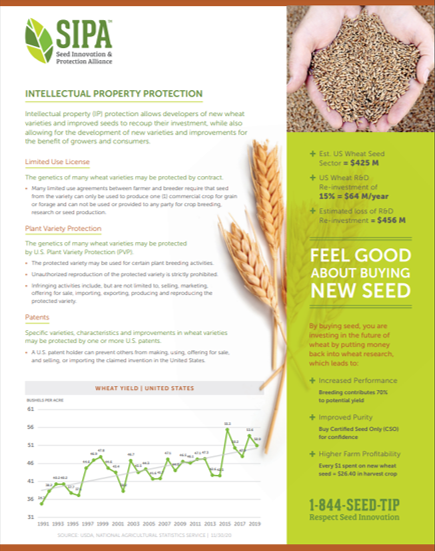
Cover of Seed Innovation and Protection Alliance Intellectual Property Protection fact sheet

Cover Crops Considerations Guide by AOSCA and ASTA (PDF)

Ag Law in the Field Podcast: “Seed Law”

This free podcast discusses when farmers can save seeds, protections in place for seed companies, patent law, the Plant Variety Protection Act and license agreements.
Ag Law in the Field podcast cover

Quality, Professional Environmental, Conservation and Cover Crop Seed Dealers in Your Region

It’s important to buy seed from a professional seed dealer. Find seed dealers for environment & conservation seed, cover crop seed, and pollinator mixes in your area using this interactive map from the American Seed Trade Association.

American Seed Trade Association interactive seed dealer map cover